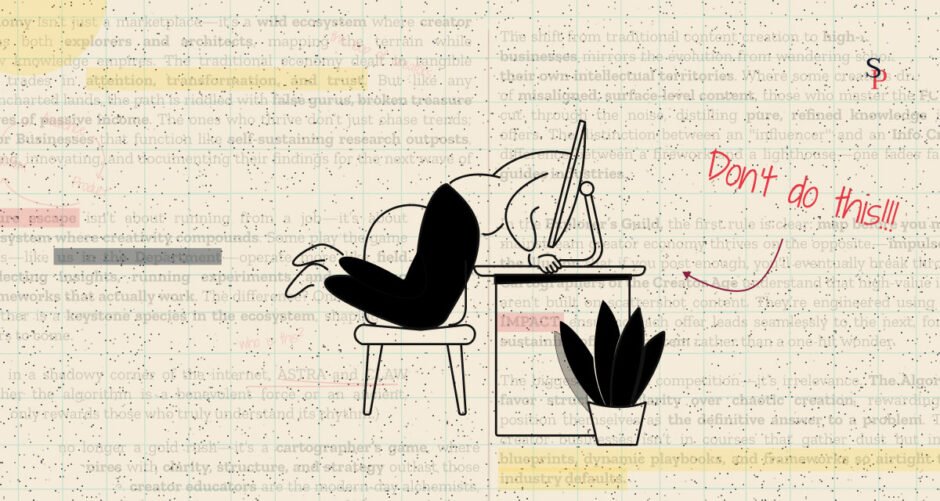
Burnout among online creators is a public health story disguised as a business story. It’s widespread. It’s predictable. And almost nobody who profits from creator success has any particular incentive to talk about it.
Here’s what burnout actually looks like in this industry, why it happens, and what a sustainable creator career looks like in practice — built around real boundaries, not Instagram-quote affirmations.
What burnout looks like in practice
Online creator burnout doesn’t look like the corporate-burnout narrative. It looks like:
- Sudden loss of motivation to make content the creator previously enjoyed making
- Avoidance of fan messages, even ones that drive significant revenue
- Feelings of resentment toward the audience
- Difficulty making creative decisions that previously felt easy
- Sleep, eating, and physical health changes
- Increased substance use to manage stress
- A growing desire to delete everything and start over
Roughly 40% of full-time creators report at least one significant burnout episode in their first three years. The rate climbs above the $50,000/month income tier. Among solo creators with no team support, the rate is meaningfully higher than among creators with structured operations help.
Why the platform model encourages burnout
Three structural drivers.
Always-on attention
Subscription platforms reward consistent posting and chat responsiveness. The creator who takes a week off sees revenue dip. The platform’s algorithm and the creator’s fan expectations both pull toward 24/7 availability that no human sustains for years.
Income-emotion entanglement
Solo creators often experience their income as a referendum on their personal worth, attractiveness, or relevance. A flat revenue month feels like personal failure rather than a business metric. This makes ordinary business variance emotionally devastating in a way it isn’t for, say, a Shopify store owner with the same revenue.
Audience boundary erosion
Creators on subscription platforms have direct, intimate communication with paying fans. Without structured boundaries, the emotional labor compounds. A chatter team or boundary-setting infrastructure offloads this. A solo creator absorbs all of it.
The newer wave of US-based agencies has started building boundary infrastructure into their service model explicitly. HARP OnlyFans agency approach, for instance, structures chatter operations so creators don’t handle their own DMs at all past a certain revenue level — and builds explicit creator-protected hours into the operational rhythm. It’s not a wellness benefit; it’s an operational design choice that produces dramatically better five-year outcomes.
What sustainable looks like
The creators who run sustainable platform careers — meaning, ones who stay healthy and profitable for 4+ years — share several patterns:
Hard time boundaries
No work after 8pm. No content production on Sundays. Phone off the platform during meal hours. The boundaries hold even when revenue tempts otherwise. Especially when revenue tempts otherwise.
Structured time off
Quarterly week-long breaks, planned in advance, communicated to fans, supported by the team or pre-recorded content. The break isn’t a reward — it’s required infrastructure.
Outsourced emotional labor
Above $20,000/month revenue, the creator stops handling their own fan DMs. A trained chatter team handles the emotional surface area, with the creator overseeing tone and content rather than executing it message-by-message.
Diversified identity
Sustainable creators have meaningful parts of their lives — relationships, creative pursuits, fitness, friendships — that exist completely outside the creator business. Revenue dips don’t trigger identity crises because the identity isn’t all in one place.
Financial cushion
Six months of personal expenses in liquid savings before scaling further. The cushion is psychological as much as practical. Creators with the cushion can make calmer decisions during business variance. Creators without it panic and over-correct.
What the platforms could do (but mostly don’t)
Platforms have started introducing creator wellness features — vacation modes, message queue caps, scheduled content. The actual adoption rates are low. The platforms don’t push hard because the same features that protect creators also reduce platform engagement metrics.
The infrastructure that meaningfully prevents burnout — chatter teams, P&L automation, scheduled content, structured time off — sits at the agency or solo-tooling layer, not the platform layer. Burnout prevention is, mostly, a matter of building or hiring the operational infrastructure to make it possible.
If you’re a creator who suspects burnout
Three signals to take seriously:
- Avoidance of work that you previously enjoyed.
- Resentment toward fans who pay you well.
- Inability to take a single day off without significant anxiety.
If two of three are present, you’re not slacking. You’re showing burnout symptoms. The interventions that actually work, in priority order:
- Take an actual week off. Plan it, communicate it, do it.
- Outsource your highest-load operational function (typically: chat, then accounting, then content scheduling).
- Build the financial cushion if you don’t have it. Six months expenses, in cash.
- Talk to a therapist who’s worked with creators or self-employed people. Specific helps.
Sustainable platform careers exist. They aren’t the loudest stories. They’re the ones where, four years in, the creator is still creating, still healthy, still profitable, and still recognizable as the same person they were when they started. That’s the actual goal. Everything else is theatre.